

Designing an invitation suite often feels like a purely aesthetic pursuit. Creators obsess over typography, color palettes, tactile paper stocks, and intricate finishes like foil stamping or wax seals. Yet, even the most breathtaking stationery design is ultimately a functional mailing vehicle. If an invitation fails to navigate the automated sorting machinery of the postal service, the result is damaged envelopes, returned mail marked for insufficient postage, or delayed arrivals that derail event timelines.
Bridging the gap between creative vision and logistics requires an understanding of dimensional standards, weight thresholds, and material regulations. By engineering your invitation suites around established postal rules from the initial concept, you can protect your budget, safeguard your stationery from mechanical damage, and ensure your guests receive an unblemished presentation.
Understanding Postal Automation and Machinability
The modern postal network processes millions of letters each day through high-speed automated sorting machines. These machines move mail pieces across motorized belts and rollers at speeds exceeding ten miles per hour, reading addresses with optical character recognition scanners.
To pass safely through this automated stream, a piece of mail must be classified as machinable. A machinable letter must meet strict dimensional, structural, and flexibility parameters:
-
The dimensions must be at least 3.5 inches high by 5 inches long, and at least 0.007 inches thick.
-
The maximum dimensions cannot exceed 6.125 inches high by 11.5 inches long, or 0.25 inches in thickness.
-
The aspect ratio—calculated by dividing the length by the height—must fall between 1.3 and 2.5.
When an envelope fails any of these criteria, it cannot pass through automated rollers. Instead, postal workers must separate and sort it by hand, triggering an automatic non-machinable surcharge that adds significant cost across a large guest list.
Navigating Standard Invitation Dimensions
Choosing a standard commercial envelope size is the most dependable way to avoid logistical friction. Standardized stationery formats align directly with common paper sheet conversions, envelope manufacturing lines, and postal scanning equipment.
The Reliable A7 Format
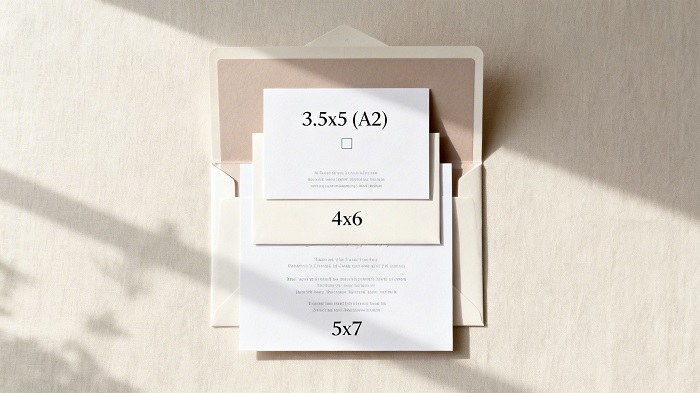
The A7 invitation size—measuring 5 inches by 7 inches, housed inside a 5.25-inch by 7.25-inch envelope—reigns as the undisputed standard for weddings, galas, and formal celebrations. It provides a generous canvas for typography and decorative framing while fitting comfortably within machinable letter limits. With an aspect ratio of roughly 1.38, an A7 envelope easily clears the 1.3 minimum ratio requirement, allowing it to mail at the base domestic letter rate provided its weight and thickness remain within standard bounds.
Supporting Enclosures with A2 and A6 Formats
Elaborate events frequently require supplementary cards for RSVP responses, travel directions, weekend itineraries, or reception details.
The A2 format (4.25 inches by 5.5 inches) paired with a 4.375-inch by 5.75-inch envelope serves as the benchmark size for reply cards. It offers ample space for meal selections and guest counts, and because it satisfies minimum letter dimensions, guests can mail their completed cards back using standard postage.
The slightly larger A6 format (4.5 inches by 6.25 inches) works exceptionally well for save-the-dates or secondary event cards that require more editorial space without dwarfing the primary invitation.
Modern Elongated Formats
For couples or corporate organizers seeking a sleek, contemporary aesthetic, No. 10 or tea-length formats (measuring approximately 3.875 inches by 9.25 inches) provide an elegant, vertical presentation. These slender dimensions fit effortlessly within machinable length boundaries while offering a distinct visual departure from traditional stationery dimensions.
The Hidden Costs of Square and Custom Envelopes
Square envelopes present an undeniable design appeal. Their symmetrical proportions create a modern, high-end feel that instantly stands out inside a mailbox. However, square stationery carries logistical complications that many hosts overlook.
Because a square envelope has identical height and length, its aspect ratio is exactly 1.0. This places it below the postal service’s 1.3 machinable threshold. As a result, every square envelope is automatically classified as non-machinable, regardless of whether it weighs under one ounce.
Automated sorting arms cannot properly orient square envelopes, which means postal employees must hand-feed or manually route them. To mail a square piece, you must pay the non-machinable surcharge on every single invitation. Furthermore, manual handling increases the likelihood of human sorting errors and transit delays.
If you love the balanced look of a square card, consider mounting a square invitation card onto a rectangular backing, or placing a square card inside a standard A7 rectangular envelope. This design compromise preserves the interior symmetry while keeping the exterior mailer fully machinable.
Managing Weight, Thickness, and Internal Rigidity
Envelope dimensions represent only half of the postal equation; internal composition matters just as much. A standard domestic letter rate covers a piece weighing up to one ounce, but an invitation suite with multiple inserts quickly exceeds that boundary.
The Compounding Weight of Inserts
A heavy cotton cardstock invitation, an RSVP card with its dedicated envelope, a double-sided details card, and a decorative vellum wrap can easily push the total weight beyond one ounce. Crossing into the second or third ounce bracket requires incremental postage. Calculating postage based on a single sample card without all inserts inserted will result in underpaid postage and mass mail returns.
The Quarter-Inch Thickness Limit
A letter must measure no more than one-quarter inch thick to qualify for letter rates. Multi-layered invitation boards, accordion-fold itineraries, and thick cardstock duplexing can cause an envelope to bulge past this boundary. If an envelope exceeds 0.25 inches in thickness, postal regulations reclassify it from a letter to a large envelope (flat) or a package, dramatically increasing the mailing cost per piece.
Material Flexibility
Postal machines curve mail around internal drums during transit. If an invitation card is constructed from rigid acrylic, thick wood veneer, metal, or dense compressed museum board that cannot bend smoothly, sorting equipment will jam. Rigid pieces are subject to the non-machinable surcharge, and in extreme cases where the item cannot bend at all, the postal service may mandate parcel rates.
Safeguarding Embellishments and Surface Treatments
Modern luxury stationery often incorporates three-dimensional textures: wax seals, silk ribbon ties, twine wraps, and vintage wax-dipped closures. While these elements lend an artisanal charm to the suite, they are uniquely vulnerable to postal machinery.
Automated sorting rollers exert tremendous mechanical pressure. A wax seal applied directly to the outside of a mailing envelope can easily be sheared off, tearing the envelope and leaving the contents exposed. Similarly, ribbon knots create an uneven thickness profile, causing the piece to catch on sorting belts.
To preserve delicate embellishments, adopt the traditional inner-outer envelope system:
-
The inner envelope houses the invitation card, ribbon closure, and decorative wax seal, remaining unsealed and pristine.
-
The outer envelope carries the recipient’s mailing address, return address, and postage, providing a smooth, durable barrier that shields the inner art from dirt, moisture, and conveyor friction.
If you are shipping a suite featuring rigid acrylic boards or delicate floral elements, abandon standard paper envelopes entirely. Ship the piece inside a bubble mailer or a rigid cardboard stay-flat mailer, mailing it as a lightweight parcel to ensure it arrives in mint condition.
The Essential Pre-Production Mailing Protocol
The most critical step in producing an invitation suite takes place before sending the design to the commercial press. Never finalize print quantities or purchase postage based on digital file calculations or bathroom scale estimates.
Assemble one complete, finished physical mockup of your invitation suite. Include the primary card, all planned insert slips, the reply envelope with its stamp affixed, the belly band or ribbon wrap, the wax seal, and the outer mailing envelope.
Take this exact prototype to your local post office and have an experienced retail clerk weigh and measure it. Ask the clerk to check its flexibility, confirm its aspect ratio, verify the thickness against their physical measurement slot, and quote the exact required postage rate.
Taking the time to confirm postal compliance early in the creative process guarantees that your invitations deliver maximum aesthetic impact without unexpected expenses, delivery failures, or transit damage.

Comments are closed.